

Before signing an exchange agreement, you must verify that your Qualified Intermediary (QI) can safely hold your funds and execute your specific transaction structure. A QI is a neutral third party required by the IRS to hold exchange proceeds and prevent you from taking constructive receipt of the funds. The right partner protects your deferral, while the wrong one risks your entire tax position. This guide outlines the critical questions to ask before you commit.
1. How Are Your Exchange Funds Secured?
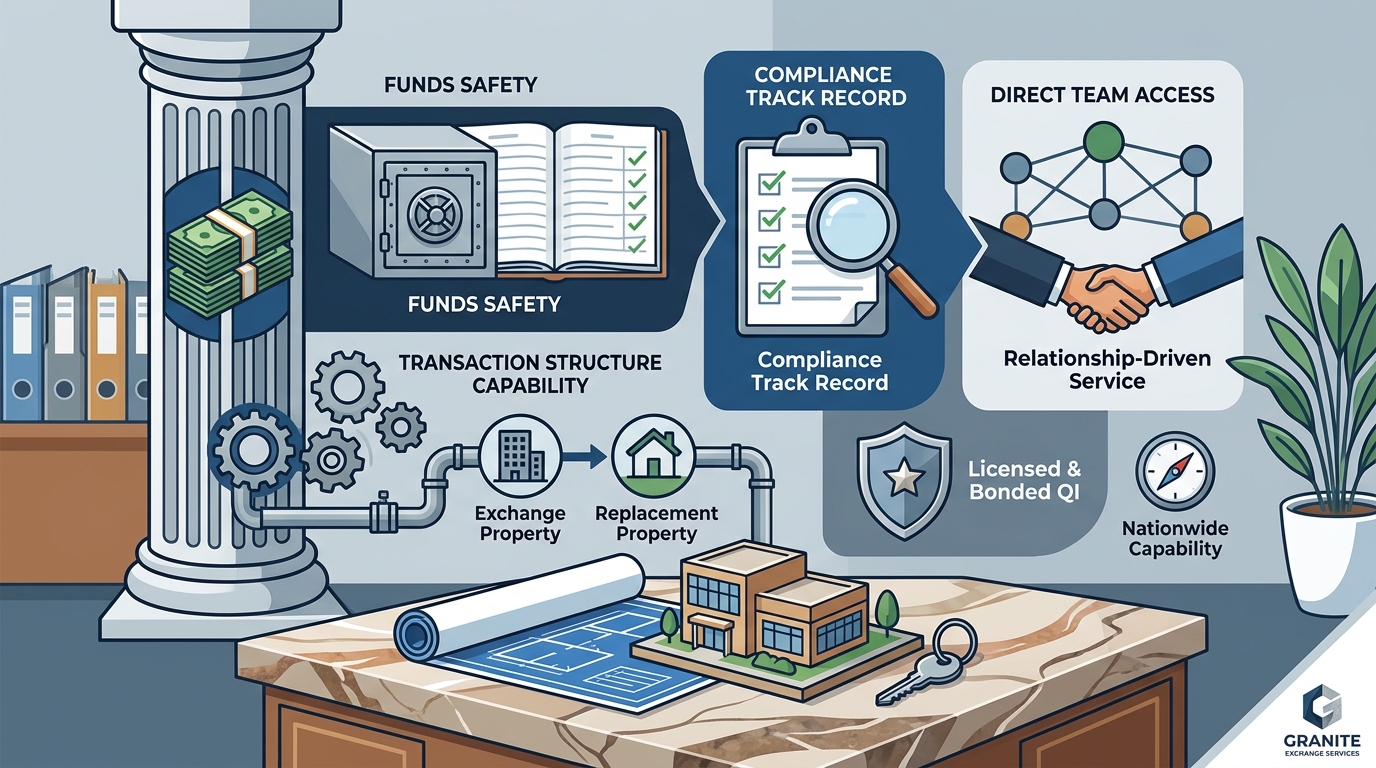
The most important question concerns the safety of your capital. You must ask how the QI holds your funds and whether those accounts are segregated. A reputable QI holds funds in segregated, FDIC-insured accounts, ensuring your money is never commingled with the company's operating capital or other clients' funds. This separation is a fundamental safeguard against financial loss.
At Granite Exchange Services, we prioritize this security by maintaining segregated accounts for every client. We have safeguarded over $1 billion in exchange funds since 2000, demonstrating a long-term commitment to protecting investor capital. When you ask about fund security, you are testing the QI's operational discipline and their respect for your financial safety.
2. What Is Your Company's Ownership Structure?
Independence is a critical factor in choosing a QI. You should ask if the company is owned by a title company, escrow company, or lender. A QI is a neutral third party that must remain independent to avoid conflicts of interest. If your QI is owned by a lender, they may have incentives to steer you toward specific financing options or properties that benefit their parent company rather than your tax deferral.
Granite Exchange Services operates as an independent, relationship-driven business. We are not owned by a title, escrow, or lender company, which allows us to function as a truly neutral accommodator. This independence ensures that our only goal is to execute your exchange correctly and keep your tax deferral intact, without hidden corporate agendas.
3. Who Will Actually Handle My Exchange?
Corporate QIs often use a call center model where you are handed off to different representatives at each stage. You must ask who your primary point of contact will be and whether that person will manage your file from start to finish. Direct access to a knowledgeable specialist ensures that your specific questions are answered accurately and promptly.
We take a hands-on, boutique approach to client service. When you work with us, you get direct access to our team rather than being buried in a corporate hierarchy. This model is particularly beneficial for commercial investors and individual landlords who need clear, consistent communication during a high-stakes transaction. You should expect a QI to provide you with a named specialist who knows your file inside and out.
4. Do You Handle My Specific Exchange Type?
Not all exchanges are created equal. A standard forward exchange is different from a reverse exchange or a construction exchange. You must ask if the QI has experience with your specific transaction type. For example, a reverse exchange, where you buy the replacement property before selling the relinquished property, requires complex documentation and funding structures that not all QIs handle routinely.
We handle every exchange structure, including delayed, reverse, improvement, and DST exchanges. Whether you are a small landlord with one rental property or an investor group managing a portfolio, we have the expertise to guide your specific deal. Asking about their experience with your exact scenario helps you verify that they can navigate the unique deadlines and paperwork requirements of your transaction.
5. How Do You Manage the 45 and 180-Day Deadlines?
The IRS imposes strict deadlines that cannot be extended. You must ask how the QI tracks and enforces the 45-day identification and 180-day completion deadlines. A robust QI uses automated systems to monitor these dates and provides clear reminders to you and your other professionals. Missing a single deadline can invalidate your entire exchange, turning a tax-deferred transaction into a taxable event.
We provide tools like our exchange deadline calculator to help you understand your timeline. Our team actively manages these deadlines on your behalf, ensuring that your identification forms are filed on time and your closing occurs within the 180-day window. This proactive management is a key differentiator between a passive document holder and an active exchange partner.
6. What Is Your Track Record and Certification?
Experience matters in a field where mistakes are costly. You should ask how many exchanges the company has completed and whether their staff holds professional certifications. A QI is a specialized service provider, and their track record is the best indicator of their reliability. Look for firms that have been in business for decades and have completed thousands of successful exchanges.
Granite Exchange Services has closed over 20,000 exchanges since 2000. Our team includes Certified Exchange Specialists (CES), a credential that demonstrates advanced knowledge of 1031 exchange rules. This combination of volume and certification provides a strong safety net for your transaction. When you ask about their history, you are assessing their ability to handle the nuances of federal tax code and state-specific compliance.
Key Takeaways
- Always verify that your QI holds funds in segregated, FDIC-insured accounts to protect your capital.
- Choose an independent QI that is not owned by a title, escrow, or lender company to avoid conflicts of interest.
- Ensure you have direct access to a named specialist who will manage your file from start to finish.
- Confirm that the QI has specific experience with your exchange type, such as reverse or construction exchanges.
- Ask how the QI tracks the 45-day and 180-day IRS deadlines to ensure your exchange remains valid.
- Look for a firm with a long track record and certified staff, such as a CES, to ensure technical accuracy.
Frequently Asked Questions
What is a Qualified Intermediary?
A Qualified Intermediary is a neutral third party required by the IRS to hold exchange proceeds and facilitate the transfer of property in a 1031 exchange.
Why is independence important for a QI?
Independence ensures that the QI has no financial incentive to steer you toward specific properties or lenders, allowing them to focus solely on your tax deferral.
How are exchange funds protected?
Exchange funds are protected by holding them in segregated, FDIC-insured accounts that are separate from the QI's operating capital and other clients' funds.
What is a reverse 1031 exchange?
A reverse 1031 exchange is a transaction where the investor acquires the replacement property before selling the relinquished property, requiring specific QI support.
Who should I ask for my primary point of contact?
You should ask for a named specialist who will manage your file directly, ensuring consistent communication and avoiding the handoffs common in large corporate call centers.
What certifications should a QI team have?
Look for team members who hold the Certified Exchange Specialist (CES) credential, which demonstrates advanced knowledge of 1031 exchange rules and regulations.
Start Your Exchange with Confidence
Choosing the right Qualified Intermediary is a critical step in protecting your investment. By asking these key questions, you can identify a partner that prioritizes your security, independence, and success. Contact Granite Exchange Services today to speak with a specialist and begin your exchange with confidence.