

Essential Qualification Standards for 1031 Exchange Qualified Intermediaries
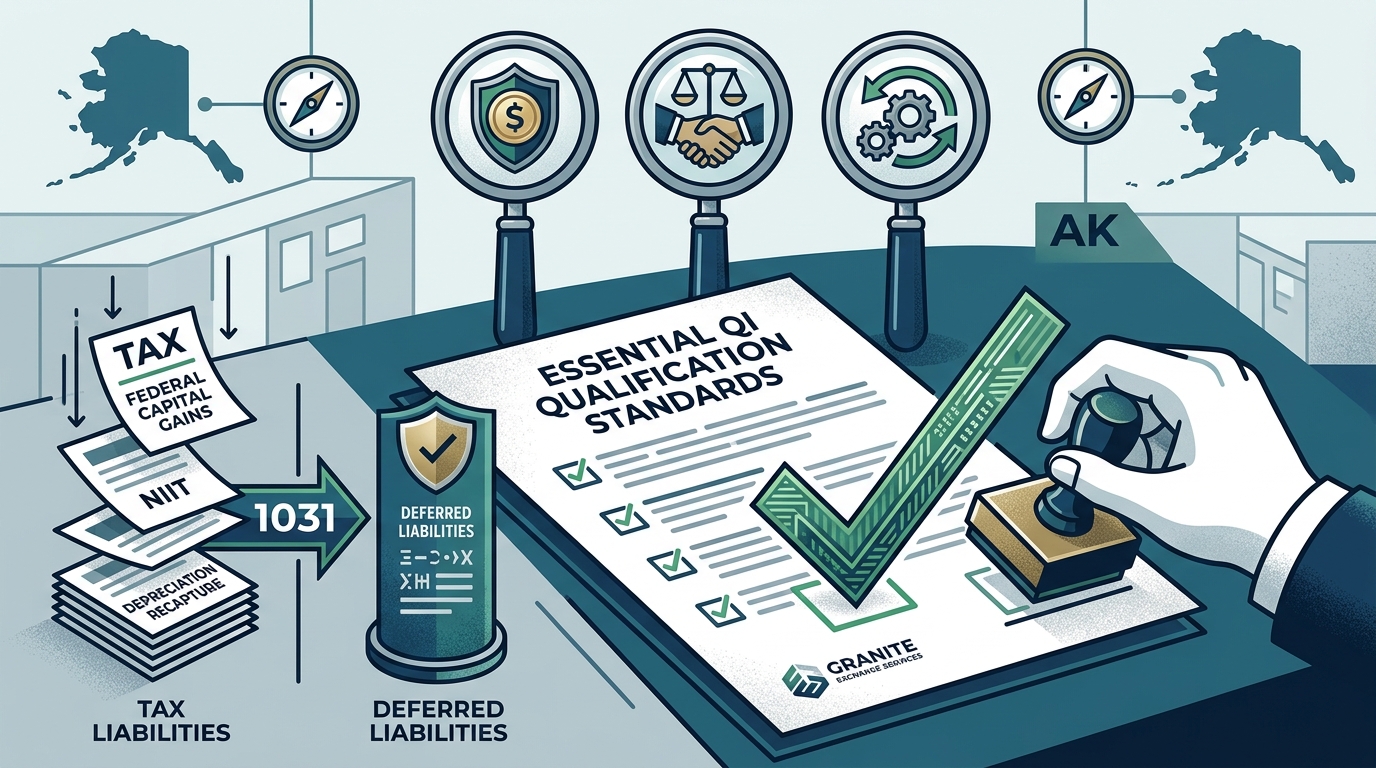
Investors face a combined tax burden exceeding 30% on investment property sales when federal capital gains, net investment income tax, and depreciation recapture converge. A properly structured 1031 exchange defers all of these liabilities, but only if the Qualified Intermediary (QI) meets strict regulatory and operational standards. Granite Exchange Services has guided investors through this complex process for over 25 years, ensuring that every exchange adheres to the highest levels of security and compliance. (1031 Exchange Alaska Granite)
Regulatory Compliance and Certification
The foundation of any qualified intermediary relationship is strict adherence to Internal Revenue Code Section 1031. This section allows taxpayers to defer capital gains taxes by exchanging like-kind properties. However, the IRS imposes rigorous standards on the QI to prevent the taxpayer from having constructive receipt of the funds. A QI must act as an independent party who holds the proceeds and facilitates the transfer without the seller's control. (1031 Exchange Alabama Granite)
One of the most critical indicators of a qualified intermediary is professional certification. The Certified Exchange Specialist (CES) designation is a rigorous credential that demonstrates a deep understanding of exchange regulations, case law, and procedural nuances. Granite Exchange Services employs CES-certified specialists who stay current with evolving tax codes and IRS guidance. This certification ensures that every exchange is handled with the precision required to avoid disqualification. (1031 Exchange Arkansas Granite)
Regulatory compliance also extends to state-specific requirements. While Section 1031 is federal, states like California and Alabama have their own reporting and tax implications. For instance, California tracks deferred gains with an annual FTB filing, requiring the QI to manage these administrative details meticulously. A qualified intermediary must be proficient in navigating these state-level complexities to ensure seamless compliance across all 50 states. (1031 Exchange Colorado Flat)
Fund Security and Segregation
The safety of exchange funds is the most vital aspect of the intermediary's role. A qualified intermediary holds your proceeds during the exchange, making the custody arrangement the real product. The standard for fund security is non-negotiable: funds must be held in segregated, FDIC-insured accounts. This segregation ensures that one client's funds are never commingled with another's, protecting your capital from the intermediary's potential financial distress.
Granite Exchange Services maintains one account per exchange, held in the exchange's specific name. This level of segregation provides an additional layer of transparency and security. Investors can verify that their funds are isolated and protected, rather than pooled into a general operating account. This practice aligns with the highest standards of financial stewardship and is a key differentiator for reputable intermediaries.
Furthermore, the intermediary must provide clear documentation of the fund custody arrangement. This includes regular statements and immediate access to fund information upon request. Transparency in fund handling builds trust and ensures that investors can monitor their capital throughout the exchange process. Any ambiguity in fund security is a red flag that should prompt investors to seek a more transparent provider.
Experience and Transaction Volume
Experience is a proxy for reliability in the 1031 exchange industry. With over 25 years in business, Granite Exchange Services has completed more than 20,000 exchanges. This volume of transactions demonstrates a proven track record of handling diverse and complex exchange scenarios. High transaction volume indicates that the intermediary has encountered and resolved a wide array of potential issues, from title company errors to deadline conflicts.
The safeguarding of over $1 billion in client funds further underscores the firm's capacity and reliability. Managing such a significant volume of capital requires robust infrastructure, rigorous internal controls, and a strong financial backbone. Investors should look for intermediaries with similar metrics of scale and longevity, as these factors correlate with stability and expertise.
Experience also translates to better client support. Seasoned intermediaries can anticipate problems before they arise and provide proactive guidance. This includes advising on complex structures like reverse exchanges or construction exchanges, which require precise timing and documentation. The ability to navigate these complexities efficiently is a direct result of years of dedicated practice and continuous education.
Insurance and Liability Protection
Financial protection mechanisms are essential for mitigating risk in 1031 exchanges. Qualified intermediaries should carry substantial errors and omissions (E&O) insurance to protect clients against potential mistakes or negligence. This insurance acts as a safety net, ensuring that investors are compensated if an error occurs due to the intermediary's fault. The amount of coverage should be commensurate with the volume of funds handled.
In addition to E&O insurance, intermediaries should maintain fidelity bonds to protect against fraud or theft. These bonds provide an extra layer of security for client funds, ensuring that they are protected from internal malfeasance. Investors should request proof of these insurance policies and verify that the coverage limits are adequate for their transaction size.
Granite Exchange Services prioritizes fund security through its comprehensive insurance portfolio and strict internal protocols. This commitment to liability protection ensures that investors can focus on their investment strategy without worrying about the safety of their capital. Understanding these protections is crucial for making an informed decision when selecting a qualified intermediary.
Technology and Deadline Management
The 1031 exchange process is governed by strict deadlines that cannot be extended. The 45-day identification period and the 180-day exchange period are absolute, with no grace period for weekends or holidays. Accurate deadline management is critical to the success of the exchange. Qualified intermediaries must use advanced technology to track these dates precisely and alert clients well in advance.
Granite Exchange Services provides a proprietary deadline calculator that computes critical dates adjusted for weekends and federal holidays. This tool ensures that investors are aware of their upcoming deadlines and can plan their property search and acquisition accordingly. The accuracy of these calculations is paramount, as a missed deadline can result in the disqualification of the entire exchange and immediate tax liability.
Technology also plays a role in document management. Qualified intermediaries should use secure digital platforms to store and share exchange documents. This ensures that all paperwork is easily accessible, organized, and protected from loss or damage. Efficient document management streamlines the exchange process and reduces the administrative burden on both the investor and the intermediary.
Key Takeaways
- Certification Matters: Look for CES-certified specialists who demonstrate deep regulatory knowledge.
- Fund Segregation: Ensure funds are held in segregated, FDIC-insured accounts to prevent commingling.
- Proven Track Record: Prioritize intermediaries with 25+ years of experience and thousands of completed exchanges.
- Insurance Coverage: Verify that the intermediary carries adequate E&O and fidelity bonds.
- Deadline Precision: Use intermediaries with robust technology to manage the 45-day and 180-day deadlines accurately.
- State Compliance: Choose a QI proficient in state-specific reporting requirements like California's FTB filings.
- Transparency: Demand clear documentation and regular updates on fund status and exchange progress.
Frequently Asked Questions
What is a Qualified Intermediary?
A Qualified Intermediary is an independent entity that facilitates a 1031 exchange by holding the proceeds from the sale of the relinquished property and acquiring the replacement property on behalf of the investor.
Why is fund segregation important?
Fund segregation ensures that client funds are held in separate accounts, preventing commingling with the intermediary's operating funds and protecting the capital from the intermediary's financial liabilities.
Can a Qualified Intermediary be a relative or business partner?
No. The IRS requires the QI to be an independent party. Relatives, employees, or business partners within the last two years are disqualified from serving as the intermediary.
What happens if the 45-day identification deadline is missed?
If the 45-day deadline is missed, the exchange is disqualified, and the investor becomes immediately liable for all capital gains taxes, depreciation recapture, and any applicable state taxes on the sale.
How does Granite Exchange Services protect client funds?
Granite Exchange Services holds funds in segregated, FDIC-insured accounts, one per exchange, and maintains comprehensive errors and omissions insurance to protect client capital.
Does Alabama tax 1031 exchanges?
Alabama conforms to federal 1031 treatment, but investors must still manage state-specific reporting and potential withholding requirements for non-resident sellers.
What is the CES certification?
The Certified Exchange Specialist (CES) designation is a professional credential that demonstrates advanced knowledge and expertise in 1031 exchange regulations and procedures.
Begin Your Exchange
Choosing the right qualified intermediary is a critical decision that impacts your financial outcome. Granite Exchange Services offers the expertise, security, and technology required to execute a flawless 1031 exchange. With over 25 years of experience and a commitment to client protection, we provide the solid ground you need for your next investment.
Start your exchange today by visiting our home page or contacting our specialists directly. We are ready to help you defer your taxes and grow your wealth with confidence.