

Granite Exchange Services is a qualified intermediary that serves investors in all 50 states. This guide explains how to choose a nationwide provider, what to ask, and how to verify credentials. It covers the exchange process, costs, common mistakes, and state-specific rules to help you protect your capital.
How to Choose a Qualified Intermediary
Selecting the right partner is critical because the intermediary holds your funds and manages the legal documentation. A qualified intermediary is a third-party entity that facilitates the exchange to ensure compliance with IRS Section 1031. You should look for a provider that is independent and not owned by a title, escrow, or lender company. Independence ensures that the intermediary acts as a neutral party, prioritizing your tax deferral over closing speed or lender requirements.
Experience and scale are also vital metrics. A provider with a long track record, such as one operating since 2000, has likely navigated various market cycles and regulatory updates. You want a team that offers direct access to specialists rather than a call center. When you call, you should speak with a person who understands the specific nuances of your transaction, not a script-reading representative.
Independence and Neutrality
Corporate providers often have conflicts of interest because they are tied to real estate transactions. An independent firm like Granite Exchange Services focuses solely on the exchange process. This separation allows them to advise you on structuring the deal to maximize tax benefits without pressure to close a title or loan transaction.
Direct Access to Specialists
Customer service quality is a differentiator. In a large corporate structure, your file may be passed between multiple departments. In a boutique or relationship-driven firm, you work with a dedicated specialist who guides you from the initial consultation through the final closing. This continuity reduces errors and ensures that your specific questions are answered by someone who knows your file.
Questions to Ask Before Committing
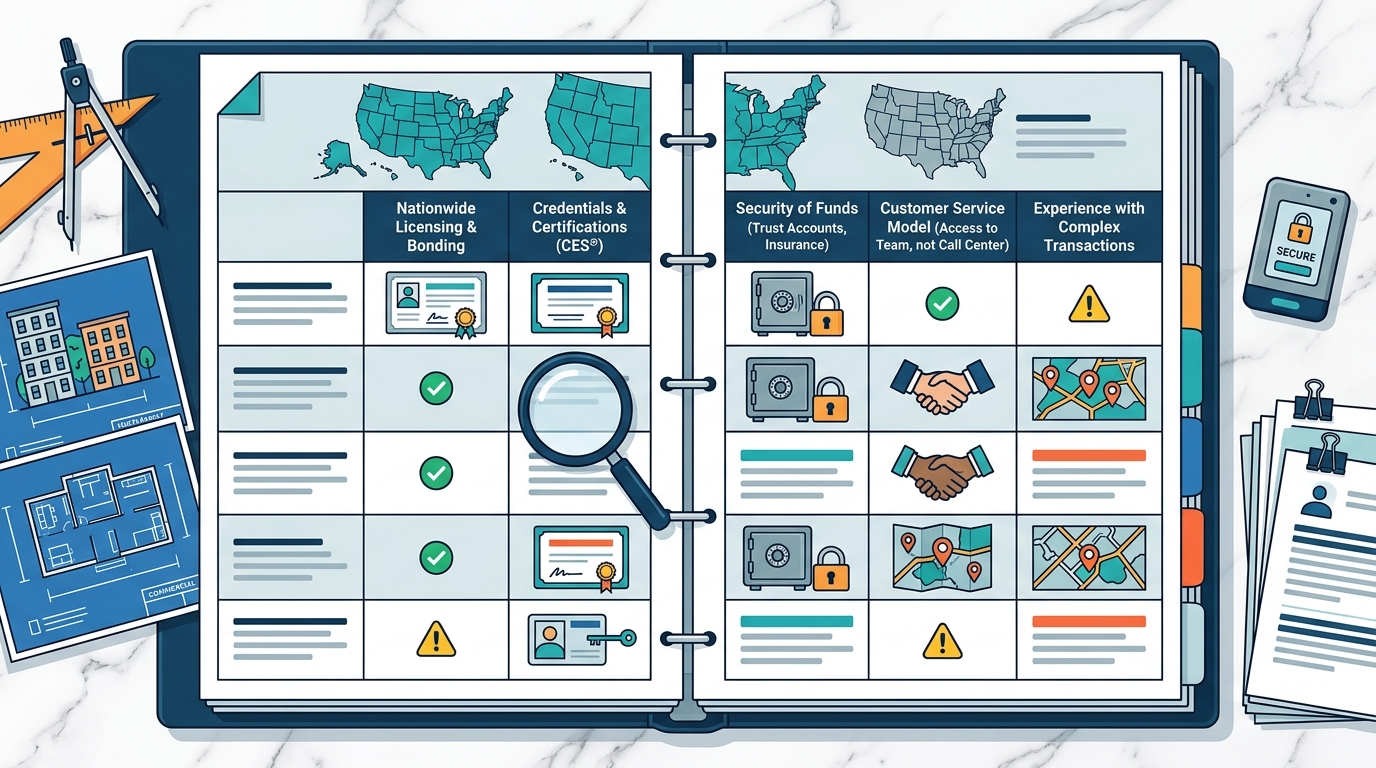
Before signing an exchange agreement, you must ask specific questions to gauge the provider's capability. First, ask about their fund security. How are your exchange proceeds held? The safest method is in segregated, FDIC-insured accounts. This ensures that your money is protected from the intermediary's own financial risks and is not commingled with other clients' funds.
Second, ask about their experience with your specific property type. Do they handle multifamily, commercial, or agricultural land? A provider that serves all 50 states should have experience with diverse asset classes. Third, ask about their process for handling complex structures, such as reverse exchanges or improvement exchanges. These require more documentation and coordination than a standard forward exchange.
Fund Security and Insurance
Verify that the provider uses segregated accounts. Ask if they have a history of protecting funds during market downturns. A reputable firm will have a clear policy on how funds are held and insured, often exceeding the standard FDIC limits through multiple banking partners.
Communication and Support
Ask how you will communicate with your team. Will you have a dedicated point of contact? What are their response times? A provider that values customer service will offer clear communication channels and responsive support, ensuring you are never left in the dark during a high-stakes transaction.
How to Verify Credentials and Claims
Do not take marketing claims at face value. You should verify the credentials of the individuals handling your exchange. Look for certifications such as the Certified Exchange Specialist (CES) designation. This certification indicates that the specialist has passed rigorous exams on 1031 exchange rules and best practices. It is a mark of professionalism and ongoing education.
Check the company's history and reputation. Look for verified reviews and testimonials from past clients. A company that has been in business for over 25 years and has closed thousands of exchanges has a track record you can investigate. You can also check for any regulatory actions or complaints against the firm. Transparency in their history is a sign of a trustworthy partner.
Certifications and Training
The CES certification is a specific credential that distinguishes knowledgeable professionals from generalists. Ask your intermediary if their team holds this certification. It demonstrates a commitment to staying current with IRS regulations and exchange best practices.
Track Record and Reviews
Search for independent reviews and client testimonials. Look for patterns in the feedback. Are clients praising the responsiveness and expertise? Are there complaints about delays or errors? A consistent pattern of positive feedback across multiple platforms is a strong indicator of reliability.
The Exchange Process and Timeline
Understanding the sequence of events helps you manage expectations. A standard delayed exchange begins when you sell your relinquished property. The proceeds are sent to the qualified intermediary, who holds them in a segregated account. You then have 45 days to identify replacement properties and 180 days to close on them. The intermediary manages the paperwork, ensuring that the IRS requirements are met at every step.
The timeline is strict. The 45-day identification period and the 180-day closing period are absolute deadlines. Missing either one disqualifies the exchange, making the entire gain taxable. A good intermediary will help you plan your search and closing to fit within these windows. They will also prepare the necessary documents, such as the exchange agreement and the assignment of the purchase contract.
Step-by-Step Process
1. Sign the Exchange Agreement. 2. Sell the Relinquished Property. 3. Funds go to the QI. 4. Identify Replacement Properties (45 days). 5. Close on Replacement Property (180 days). 6. QI delivers funds and documents. 7. File tax returns with Form 8824.
Documentation and Coordination
The intermediary coordinates with your title company, attorney, and CPA. They ensure that the closing documents are structured correctly to reflect the exchange. This coordination is crucial to avoid errors that could jeopardize the tax deferral.
Costs and Fee Structures
The cost of a 1031 exchange varies based on the complexity of the transaction and the amount of funds involved. Most qualified intermediaries charge a flat fee for a standard delayed exchange. This fee covers the preparation of documents, fund management, and coordination with other parties. For more complex structures, such as reverse exchanges or improvement exchanges, the fee may be higher due to the additional work required.
It is important to understand what is included in the fee. Does it cover the cost of the exchange agreement? Does it include the cost of the assignment? Are there additional fees for holding funds? A transparent fee structure helps you budget for the transaction. Avoid providers that have hidden fees or unclear pricing. A reputable firm will provide a clear breakdown of costs before you sign the agreement.
Factors Influencing Cost
The amount of exchange funds, the number of properties involved, and the type of exchange all affect the price. A simple exchange of one property for another is less expensive than a portfolio exchange involving multiple properties. A reverse exchange, where you buy before you sell, is more complex and typically costs more than a delayed exchange.
Value vs. Price
While cost is a factor, it should not be the only one. The value of the service lies in the protection of your tax deferral. A slightly higher fee for a more experienced and independent provider may be worth it if it reduces the risk of errors. Consider the total value of the tax savings you are protecting when evaluating the cost.
Common Mistakes and How to Avoid Them
Many exchanges fail due to simple errors. One common mistake is missing the 45-day identification deadline. Investors often spend too much time searching for the perfect property and run out of time. To avoid this, start your search early and have a list of potential properties ready. Another mistake is receiving boot, which is cash or debt relief that is not reinvested. Boot is taxable. To avoid this, ensure that you reinvest all proceeds and do not reduce your debt below the original amount.
Another error is failing to use a qualified intermediary. If you take possession of the funds or the property before the exchange is complete, you disqualify the transaction. The intermediary must hold the funds and the title. Finally, failing to file the correct tax forms can lead to penalties. You must file Form 8824 with your tax return to report the exchange. A good intermediary will provide you with the necessary documentation to file correctly.
Missing Deadlines
The 45-day and 180-day deadlines are strict. There are no extensions. Plan your search and closing schedule carefully. Work with your intermediary to create a timeline that accounts for contingencies.
Receiving Boot
Boot is any cash or debt relief you receive that is not reinvested. It is taxable. To avoid boot, reinvest all proceeds and ensure that your new debt is at least as high as your old debt. If you need cash, consider a partial exchange, but be aware that the boot portion will be taxable.
Independent vs. Corporate Providers
Choosing between an independent firm and a large corporate provider is a significant decision. Corporate providers often have the advantage of scale and brand recognition. However, they may lack the personalized service and independence that an independent firm offers. An independent provider, such as Granite Exchange Services, is not tied to a title or lender company. This neutrality allows them to focus solely on your best interests.
Corporate providers may use a call center model, where you speak with different representatives at different stages of the process. This can lead to miscommunication and delays. An independent firm often uses a relationship-driven model, where you work with a dedicated specialist who knows your file. This continuity improves communication and reduces errors. When comparing providers, consider the level of service and the degree of independence.
Service Model Comparison
| Ownership | Independent, no conflicts | Often owned by title/lender |
| Service Model | Dedicated specialist | Call center/rotating staff |
| Focus | Client-specific needs | High volume/standardization |
| Flexibility | High, custom solutions | Lower, rigid processes |
Conflict of Interest
Corporate providers may have incentives to close transactions quickly, which can sometimes conflict with the need for careful planning. An independent firm has no such incentives. Their goal is to ensure that the exchange is compliant and that you achieve your tax deferral. This alignment of interests is a key advantage of working with an independent provider.
Situational Guidance for Different Investors
Different investors have different needs. Commercial investors may have large portfolios and complex structures. They need a provider that can handle multi-property exchanges and large amounts of funds. Small individual landlords may have a single rental property. They need a provider that can explain the process clearly and guide them through their first exchange. Private investors and hedge funds may have specific tax strategies. They need a provider that can work with their CPAs and attorneys to structure the exchange correctly.
Regardless of your situation, you need a provider that can serve you in your state. A provider that serves all 50 states has the experience to handle state-specific rules and market nuances. They can advise you on the best replacement properties and help you navigate local regulations. This breadth of experience is a key advantage of a nationwide provider.
Commercial Investors
Commercial investors often have multiple properties and large amounts of equity. They need a provider that can handle complex structures, such as portfolio exchanges or improvement exchanges. They also need a provider that can work with their legal and tax teams to ensure compliance.
Individual Landlords
Individual landlords may be new to 1031 exchanges. They need a provider that can explain the process in simple terms and guide them through each step. They also need a provider that can help them find suitable replacement properties in their area.
IRS Rules and Investor Protections
The IRS has strict rules for 1031 exchanges. The most important rule is that the properties must be like-kind. This means that they must be held for investment or business use. Personal residences do not qualify. The properties must also be real property. You cannot exchange real estate for personal property, such as a car or a boat. The exchange must be facilitated by a qualified intermediary. You cannot take possession of the funds or the property before the exchange is complete.
Investors have certain protections under the law. The qualified intermediary is required to hold the funds in a segregated account. This protects your money from the intermediary's creditors. The intermediary is also required to follow the IRS rules and prepare the necessary documentation. If the intermediary fails to do so, you may be liable for taxes. It is important to choose a reputable intermediary that follows the rules and protects your interests.
Like-Kind Requirement
The like-kind requirement is the foundation of the 1031 exchange. Both the relinquished and replacement properties must be held for investment or business use. They must also be real property. This requirement ensures that the exchange is a genuine investment transaction, not a tax avoidance scheme.
Qualified Intermediary Role
The qualified intermediary is a neutral third party that facilitates the exchange. They hold the funds and the title, ensuring that you do not take constructive receipt of the proceeds. This role is essential for compliance with IRS rules. The intermediary is not a tax advisor, but they are responsible for ensuring that the exchange is structured correctly.
State-Specific Compliance and Market Nuances
While 1031 exchanges are governed by federal law, state-specific rules can affect the transaction. Some states have their own tax implications for real estate sales. For example, some states impose transfer taxes or capital gains taxes that are not deferred in a 1031 exchange. A provider that serves all 50 states should be familiar with these state-specific rules. They can advise you on the tax implications of selling in one state and buying in another.
Market nuances also matter. Some states have active real estate markets, while others are slower. A provider with nationwide experience can help you find suitable replacement properties in different markets. They can also advise you on the best times to buy and sell in different regions. This local knowledge is a key advantage of a nationwide provider.
State Tax Implications
Some states do not conform to federal 1031 rules. This means that you may owe state taxes even if you defer federal taxes. A provider that is familiar with state-specific rules can help you plan for these taxes. They can also advise you on the best strategies to minimize your state tax liability.
Market Experience
A provider that serves all 50 states has experience with different market conditions. They can advise you on the best replacement properties in different regions. They can also help you navigate local regulations and market trends. This experience is valuable for investors who are considering out-of-state properties.
Timing and Deadline Management
Timing is critical in a 1031 exchange. The 45-day identification period and the 180-day closing period are strict deadlines. You must identify your replacement properties within 45 days of selling your relinquished property. You must close on them within 180 days. Missing either deadline disqualifies the exchange. To manage timing, start your search early. Have a list of potential properties ready. Work with your intermediary to create a timeline that accounts for contingencies.
Market conditions can also affect timing. In a hot market, properties may sell quickly. You may need to act fast to secure a replacement property. In a slow market, you may have more time to search. A provider with nationwide experience can help you navigate these market conditions. They can advise you on the best times to buy and sell in different regions.
Managing Deadlines
Create a timeline that accounts for the 45-day and 180-day deadlines. Start your search early. Have a list of potential properties ready. Work with your intermediary to ensure that you meet the deadlines. A good intermediary will help you manage the timeline and keep you on track.
Market Conditions
Market conditions can affect the availability of replacement properties. In a hot market, you may need to act fast. In a slow market, you may have more time. A provider with nationwide experience can help you navigate these conditions. They can advise you on the best times to buy and sell in different regions.
Long-Term Outcomes and Reliability
The long-term outcome of a 1031 exchange is the deferral of capital gains taxes. This allows you to reinvest your capital and grow your portfolio. Over time, the compounding effect of tax deferral can be significant. You can exchange your properties multiple times, deferring taxes each time. This strategy allows you to build wealth without the drag of taxes. A reliable intermediary is essential to ensure that each exchange is compliant and that you achieve your tax deferral.
Reliability is demonstrated by a long track record. A provider that has been in business for over 25 years and has closed thousands of exchanges has a proven track record. They have navigated various market cycles and regulatory updates. This experience is a sign of a reliable partner. When choosing a provider, look for one with a long history and a strong reputation. This will give you confidence that they will handle your exchange correctly.
Compounding Effect
The compounding effect of tax deferral is a key benefit of 1031 exchanges. By deferring taxes, you can reinvest your capital and grow your portfolio. Over time, this can lead to significant wealth accumulation. A reliable intermediary is essential to ensure that each exchange is compliant and that you achieve your tax deferral.
Track Record
A provider with a long track record has a proven ability to handle exchanges correctly. They have navigated various market cycles and regulatory updates. This experience is a sign of a reliable partner. When choosing a provider, look for one with a long history and a strong reputation.
Key Takeaways
- Choose an independent qualified intermediary that is not owned by a title or lender company.
- Verify that the provider uses segregated, FDIC-insured accounts for fund security.
- Look for providers with the Certified Exchange Specialist (CES) certification.
- Understand the strict 45-day and 180-day deadlines for identification and closing.
- Avoid receiving boot by reinvesting all proceeds and maintaining debt levels.
- Consider the service model: dedicated specialists vs. call centers.
- Check the provider's track record and reputation in your state and nationwide.
- Work with a provider that has experience with your specific property type and market.
Frequently Asked Questions
What is a qualified intermediary?
A qualified intermediary is a third-party entity that facilitates a 1031 exchange. They hold the funds and manage the documentation to ensure compliance with IRS rules.
How long does a 1031 exchange take?
A standard delayed exchange takes up to 180 days to close. You have 45 days to identify replacement properties and 180 days to close on them.
What is boot in a 1031 exchange?
Boot is any cash or debt relief you receive that is not reinvested. It is taxable. To avoid boot, reinvest all proceeds and maintain debt levels.
Can I exchange properties in different states?
Yes, you can exchange properties in different states. The properties must be like-kind and held for investment or business use. State-specific tax rules may apply.
How much does a 1031 exchange cost?
The cost varies based on the complexity of the transaction and the amount of funds involved. Most providers charge a flat fee for a standard delayed exchange.
What is the Certified Exchange Specialist (CES) certification?
The CES certification is a credential that indicates that the specialist has passed rigorous exams on 1031 exchange rules and best practices. It is a mark of professionalism and ongoing education.
Do I need a CPA for a 1031 exchange?
Yes, you should work with a CPA to ensure that the exchange is reported correctly on your tax return. The qualified intermediary will provide you with the necessary documentation.
Can I exchange a personal residence?
No, you cannot exchange a personal residence. The properties must be held for investment or business use. Personal residences do not qualify for a 1031 exchange.