

Comparing 1031 Exchange Types: Delayed, Reverse, and Build-to-Suit Structures
Real estate investors face a significant tax burden when selling investment properties, with combined federal and state taxes often exceeding 30% of the realized gain. According to the Internal Revenue Code Section 1031, a 1031 exchange allows investors to defer these capital gains taxes by reinvesting proceeds into like-kind property. Granite Exchange Services has facilitated over 20,000 exchanges since 2000, safeguarding more than $1 billion in client funds through segregated, FDIC-insured accounts. This guide compares the primary exchange structures to help you determine the optimal path for your portfolio.
What Is a 1031 Exchange?
A 1031 exchange is a tax-deferred strategy that permits investors to swap one investment property for another without immediate capital gains tax liability. The term "like-kind" refers to the nature of the asset, not its grade or quality. For example, a commercial building can be exchanged for vacant land, provided both are held for investment or business use. This mechanism is governed by IRC Section 1031, which has remained a cornerstone of real estate wealth preservation for decades.
The core benefit is the deferral of taxes, which allows your capital to compound faster than if it were reduced by tax payments. However, the process requires strict adherence to IRS timelines and the use of a Qualified Intermediary (QI). Granite Exchange Services, a CES® Certified QI, ensures that your funds are never commingled and that all documentation meets federal standards. For a deeper understanding of the rules, review our comprehensive guide on 1031 exchanges.
The Delayed Exchange: The Standard Approach
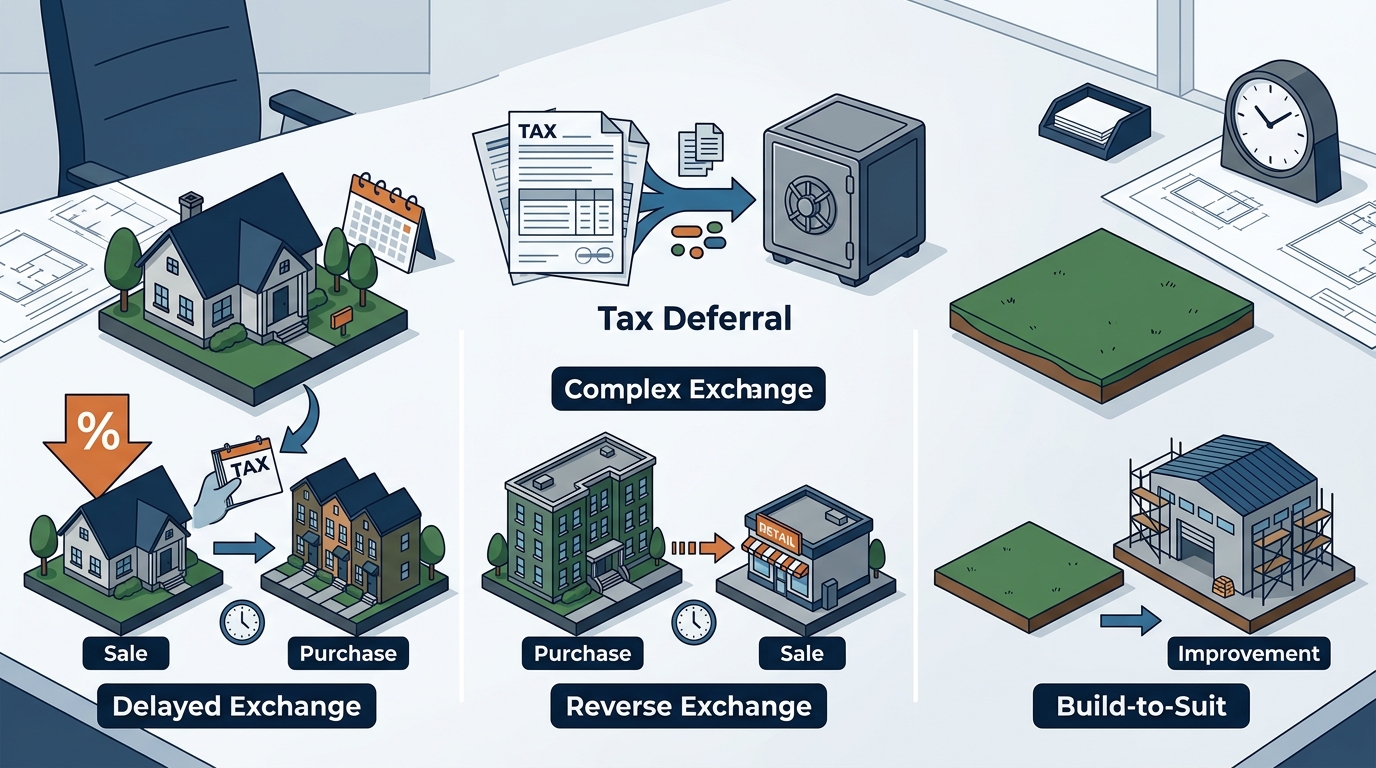
The delayed exchange, also known as a forward exchange, is the most common structure used in real estate transactions. In this scenario, you sell your relinquished property first, then identify and acquire a replacement property within strict timeframes. This structure is ideal for investors who have already found a buyer for their current asset and need time to locate a suitable replacement.
The 45-Day Identification Rule
Within 45 calendar days of closing on the sale of your relinquished property, you must formally identify potential replacement properties in writing. The IRS allows three identification strategies: the Three-Property Rule, the 200% Rule, or the 95% Rule. Failure to identify a property within this window disqualifies the entire exchange. Our 45-Day Rule guide details how to navigate these constraints effectively.
The 180-Day Completion Rule
After identification, you have 180 calendar days to close on the replacement property. This period begins on the date of the relinquished property sale and ends on the earlier of the 180th day or your tax filing deadline (including extensions). Granite Exchange Services provides a deadline calculator to help you track these critical dates accurately.
For investors selling in specific regions, state-level nuances can impact the exchange. For instance, California investors must file an annual FTB Form 3840 to track deferred gains, while Alabama investors face a 5% top income tax rate that applies to the gain if not deferred.
The Reverse Exchange: Buying Before Selling
A reverse exchange, or "parking" transaction, allows you to acquire a replacement property before selling your relinquished one. This structure is essential when you have found the perfect replacement property but your current property has not yet sold. Without a reverse exchange, you would lose the opportunity to secure the new asset due to the 45-day identification deadline.
Exchange Accommodation Titleholder (EAT)
In a reverse exchange, an Exchange Accommodation Titleholder (EAT) holds the title to the property. The EAT acts as a temporary owner, "parking" the property until you sell your relinquished asset. This process is governed by Rev. Proc. 2000-37, which provides a safe harbor for these transactions. Granite Exchange Services forms the EAT and manages the title park to ensure compliance with IRS regulations. Learn more about structuring a reverse exchange.
Strict Timelines Apply
Even though you buy first, the 180-day completion rule still applies. You must sell the relinquished property within 180 days of acquiring the replacement. This creates a dual deadline pressure that requires precise coordination. Our specialists at Granite Exchange Services monitor both sides of the transaction to ensure no deadlines are missed.
The Construction Exchange: Build-to-Suit
The construction exchange, often called a build-to-suit or improvement exchange, allows you to use exchange funds to make substantial improvements on the replacement property. This is particularly useful for investors looking to upgrade a property or develop land. The improvements must be completed within the 180-day exchange period.
Substantial Improvements Required
The IRS requires that improvements be "substantial" to qualify. Minor repairs or cosmetic updates do not count. The replacement property must be identified as the property to be acquired, and the improvements must be made before the exchange closes. This structure provides flexibility for investors who want to customize their replacement asset. See our construction exchange guide for detailed planning steps.
Title Parking During Construction
Similar to a reverse exchange, title is typically parked with an EAT during the construction phase. This ensures that the funds remain protected and that the exchange qualifies for tax deferral. Granite Exchange Services coordinates with contractors and title companies to ensure the construction timeline aligns with the 180-day deadline.
Delaware Statutory Trusts: Passive Options
For investors seeking a hands-off approach, a Delaware Statutory Trust (DST) exchange offers a passive alternative. DSTs allow you to exchange your property for fractional ownership in institutional-grade real estate. This is ideal for investors who want to diversify without managing tenants or maintenance.
Passive Ownership Benefits
DSTs provide the benefits of a 1031 exchange without the operational burdens of direct ownership. You receive a share of the income and appreciation, but the sponsor handles all management tasks. This structure is particularly popular among older investors or those looking to downsize their involvement in real estate. Explore our DST exchange options to find suitable investments.
Eligibility and Restrictions
Not all properties qualify for DST exchanges. The IRS has strict rules regarding the size and type of assets. Granite Exchange Services works with pre-vetted DST sponsors to ensure that the offerings meet your investment criteria and exchange requirements.
Exchange Structure Comparison
Understanding the differences between exchange types is crucial for making an informed decision. The table below summarizes the key features, timelines, and ideal use cases for each structure.
| Exchange Type | Order of Transactions | Key Deadline | Ideal For | Complexity |
|---|---|---|---|---|
| Delayed Exchange | Sell First, Buy Later | 45-day ID, 180-day Close | Standard sales with time to find replacement | Low |
| Reverse Exchange | Buy First, Sell Later | 180-day Sell Deadline | Competitive markets with desired replacement | High |
| Construction Exchange | Buy/Build, Then Sell | 180-day Completion | Developers or renovators | High |
| DST Exchange | Sell, Then Invest | 45-day ID, 180-day Close | Passive investors seeking diversification | Medium |
Key Takeaways
- 25+ Years of Experience: Granite Exchange Services has guided investors through over 20,000 exchanges since 2000, ensuring airtight documentation and compliance.
- $1 Billion+ Safeguarded: Client funds are held in segregated, FDIC-insured accounts, with zero commingling, providing maximum security for your capital.
- CES® Certified Specialists: Our team includes Certified Exchange Specialists who provide expert guidance on complex multi-asset and construction exchanges.
- Strict Deadlines: The 45-day identification and 180-day completion rules are absolute, with no IRS extensions available for missed dates.
- State-Specific Nuances: While federal rules apply nationwide, states like Alaska (no income tax) and California (annual tracking) have unique implications for investors.
- Reverse Exchange Complexity: Buying before selling requires an Exchange Accommodation Titleholder (EAT) and careful coordination to meet the 180-day sell deadline.
- Passive Options Available: Delaware Statutory Trusts offer a hands-off alternative for investors seeking institutional-grade real estate without management duties.
Frequently Asked Questions
What is the difference between a delayed and reverse exchange?
A delayed exchange requires you to sell the relinquished property first, then identify and buy the replacement within 45 and 180 days, respectively. A reverse exchange allows you to buy the replacement property first, then sell the relinquished property within 180 days. The reverse exchange requires an Exchange Accommodation Titleholder (EAT) to hold title temporarily.
Can I make improvements to the replacement property?
Yes, through a construction exchange. You can use exchange funds to make substantial improvements on the replacement property, provided the work is completed within the 180-day exchange period. Minor repairs do not qualify as substantial improvements.
How does a 1031 exchange work in Alaska?
Alaska has no state income tax, so investors only defer federal capital gains taxes (15-20%) and the 3.8% Net Investment Income Tax. However, federal 1031 rules still apply strictly. Granite Exchange Services assists Alaska investors with both local and out-of-state exchanges.
What is a Qualified Intermediary (QI)?
A Qualified Intermediary is a neutral third party who facilitates the 1031 exchange by holding the sale proceeds and ensuring compliance with IRS rules. Granite Exchange Services acts as your QI, providing CES® certified specialists to manage the process.
Can I exchange a personal residence?
No, 1031 exchanges only apply to property held for investment or business use. Personal residences, such as your primary home, do not qualify. However, if you have used part of your home for business, that portion may be eligible.
What happens if I miss the 45-day identification deadline?
If you miss the 45-day deadline, the exchange is disqualified, and you must pay capital gains taxes on the sale of the relinquished property. There are no extensions for this deadline, so precise planning is essential.
Are DST exchanges safe?
DST exchanges are a recognized IRS-approved method for deferring taxes. They offer passive ownership in institutional real estate. Granite Exchange Services works with vetted sponsors to ensure the offerings meet high standards of security and compliance.
Start Your Exchange
Choosing the right exchange structure is critical to maximizing your tax deferral and investment growth. Whether you need a standard delayed exchange, a complex reverse transaction, or a passive DST investment, Granite Exchange Services provides the expertise and security you need. Our CES® certified specialists are ready to guide you through every step of the process.
Do not risk your capital gains on improper documentation or missed deadlines. Contact Granite Exchange Services today to begin your exchange with confidence. Visit our contact page to speak with a specialist or use our exchange calculator to estimate your savings. Secure your financial future with the discipline of a private bank and the attention of a boutique.