

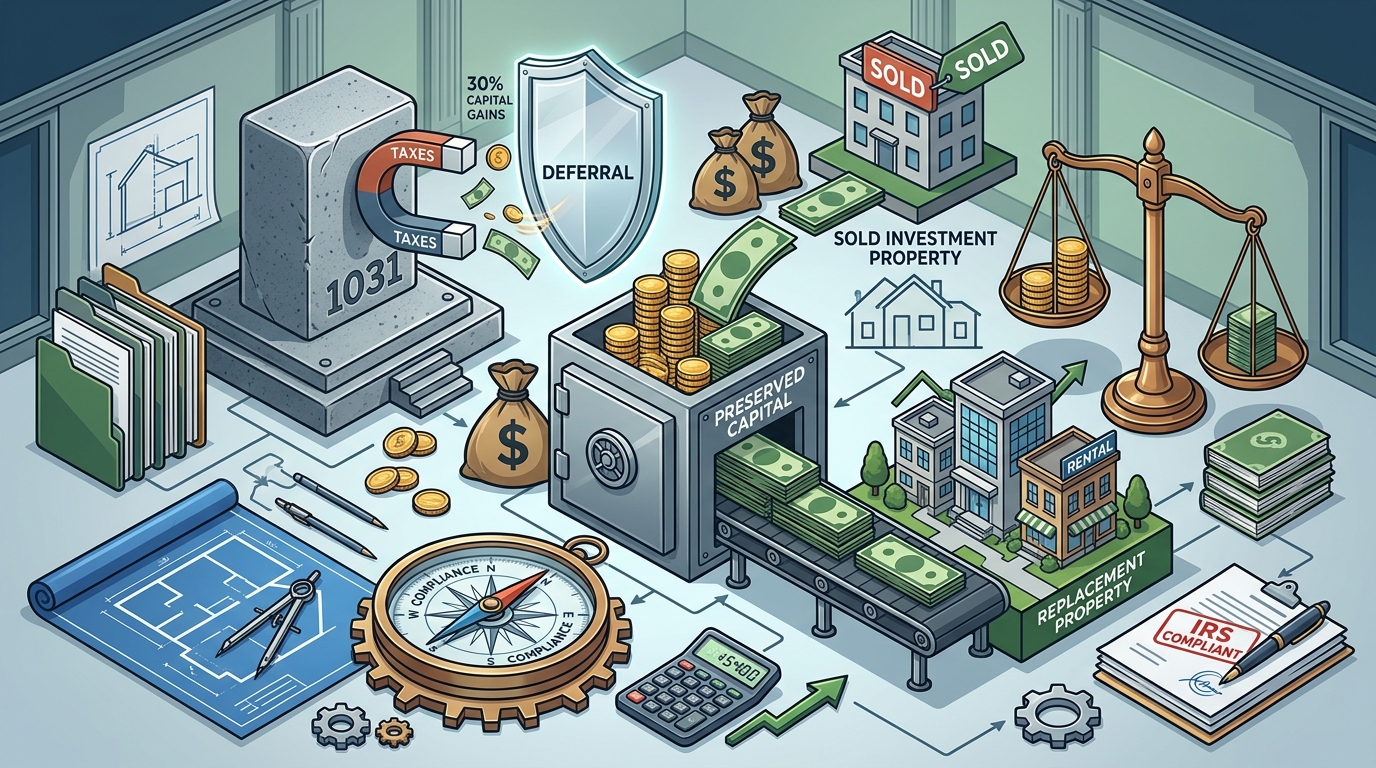
Investors selling commercial real estate or rental properties face a significant financial hurdle: capital gains taxes that can consume up to 30% of their profit. According to the Internal Revenue Code Section 1031, a properly structured exchange allows you to defer these taxes entirely, preserving your capital for future growth. Granite Exchange Services has facilitated over 20,000 such transactions since 2000, helping investors safeguard more than $1 billion in client funds. This guide details the precise mechanics, critical deadlines, and strategic structures required to execute a successful exchange.
What Is a 1031 Exchange?
A 1031 exchange, named after Section 1031 of the Internal Revenue Code, is a tax-deferred strategy that allows investors to swap one investment property for another of like-kind. The term like-kind refers to the nature of the asset rather than its grade or quality. For real estate, this means any investment property can be exchanged for any other investment property, regardless of whether you are selling a single-family rental for a multifamily complex or a commercial office building for a retail center.
The primary benefit is the deferral of capital gains taxes. When you sell a property without an exchange, the IRS requires you to pay taxes on the profit. By using a 1031 exchange, you reinvest the proceeds into a new property, effectively postponing the tax liability. This deferral can compound over time, allowing investors to build larger portfolios with the same amount of capital. For a detailed breakdown of the rules, visit our What is a 1031 Exchange? resource page.
It is crucial to understand that this is not a tax elimination strategy. The taxes are deferred until you sell the replacement property without exchanging it again. However, the time value of money makes deferral highly valuable. You can use the tax savings to acquire a larger or more profitable asset. To understand the specific rules governing these transactions, review our guide on The 45-Day Rule and The 180-Day Rule.
The Core Mechanics of the Exchange
Executing a 1031 exchange requires strict adherence to timelines and procedural requirements. The process begins with the sale of your relinquished property. You cannot receive the proceeds directly. Instead, the funds must be held by a Qualified Intermediary (QI) in a segregated, FDIC-insured account. This separation ensures that the funds are never commingled with the QI's operating capital, protecting your investment.
The first critical deadline is the 45-day identification period. You have exactly 45 calendar days from the closing of your relinquished property to identify potential replacement properties in writing. The IRS allows three main identification methods: the Three-Property Rule, the 200% Rule, or the 95% Rule. Understanding these options is vital for maximizing your acquisition choices. Learn more about Understanding Boot to avoid unintended tax liabilities.
The second deadline is the 180-day completion period. You must close on the replacement property within 180 days of selling the relinquished property, or by the tax filing deadline of the relinquished property's year, whichever is earlier. These deadlines are absolute. The IRS does not grant extensions for weekends or holidays. Our Exchange Calculator can help you track these critical dates accurately.
Exchange Structures for Every Scenario
Not all exchanges follow the standard forward path. Depending on your market conditions and financial goals, you may need a different structure. Granite Exchange Services specializes in complex transactions, ensuring compliance with IRS regulations for each type.
Delayed (Forward) Exchange
This is the most common structure. You sell your relinquished property first, then identify and acquire the replacement property. The QI holds the proceeds during the interim period. This structure is ideal when you have already found a buyer for your current asset and need time to locate a suitable replacement. For more details, see our Delayed Exchange overview.
Reverse Exchange
In a reverse exchange, you acquire the replacement property before selling the relinquished one. This is useful in competitive markets where finding a replacement quickly is essential. The QI forms an Exchange Accommodation Titleholder (EAT) to hold the title of the replacement property until you sell your original asset. This structure is governed by Rev. Proc. 2000-37. Explore our Reverse Exchange services for more information.
Construction Exchange
A construction exchange allows you to use exchange funds to make improvements on the replacement property. The title is parked with the EAT until the improvements are complete. This is ideal for investors looking to upgrade a property or build a custom facility. Learn about Construction Exchanges to see how this can enhance your property value.
DST Exchange
Delaware Statutory Trust (DST) exchanges allow for passive investment in institutional-grade real estate. You exchange your property for fractional ownership in a larger asset, such as a shopping center or apartment complex. This is ideal for investors seeking diversification without active management. Discover the benefits of DST Exchanges.
Fund Security and Qualified Intermediary Role
The choice of a Qualified Intermediary is the most critical decision in the exchange process. Your funds are held in custody during the transaction, making security paramount. Granite Exchange Services maintains segregated accounts for each exchange, ensuring that your funds are never commingled with other clients' assets or our corporate funds.
We are CES® Certified, a designation that signifies advanced expertise in exchange regulations. Our specialists provide personalized support throughout the process, from initial planning to final closing. With over 25 years of experience and more than 20,000 exchanges completed, we have established a reputation for reliability and precision. Read our full Fund Security architecture details to understand our protective measures.
Our commitment to security extends to our operational protocols. We use advanced encryption and secure data transmission methods to protect your personal and financial information. Our team is available to answer your questions at any stage of the exchange. Contact our specialists at 800-899-6959 for immediate assistance.
State-Specific Tax Implications
While Section 1031 is a federal provision, state tax laws vary significantly. Some states conform to federal rules, while others have their own requirements or do not recognize 1031 exchanges for certain property types. Understanding your state's specific regulations is crucial for accurate tax planning.
For example, California tracks deferred gains with an annual FTB filing, requiring investors to report their exchange activity even though no state tax is due at the time of the exchange. Texas, on the other hand, has no state income tax, making it a popular destination for exchange investors. We provide detailed guides for various states, including our California Guide, Texas Guide, and Florida Guide.
Other states may have specific withholding requirements for non-resident sellers. For instance, Alabama requires buyers to withhold a portion of the purchase price from non-resident sellers. Our state-specific resources help you navigate these complexities. Check our Alabama 1031 Exchange guide for more details on regional requirements.
Key Takeaways
- Deferral Power: A 1031 exchange defers capital gains taxes, allowing you to reinvest the full sale proceeds into a new property.
- Strict Deadlines: You must identify replacement properties within 45 days and close within 180 days of the relinquished property sale.
- Qualified Intermediary: A QI must hold the proceeds in a segregated account to ensure compliance and security.
- Like-Kind Definition: Investment real estate can be exchanged for any other investment real estate, regardless of type or quality.
- State Variations: State tax laws differ; some require additional filings or have specific withholding rules.
- Exchange Types: Delayed, reverse, construction, and DST exchanges offer flexibility for different market conditions.
- Expert Guidance: Working with a CES® certified specialist like Granite Exchange Services ensures compliance and peace of mind.
Frequently Asked Questions
What is the primary benefit of a 1031 exchange?
The primary benefit is the deferral of capital gains taxes. This allows investors to preserve their capital and compound their wealth by acquiring larger or more profitable properties without the immediate tax burden.
Can I exchange a personal residence for an investment property?
No. Section 1031 applies only to property held for productive use in a trade or business or for investment. Personal residences do not qualify. However, if you have used a portion of your home for rental purposes, that portion may qualify.
What happens if I miss the 45-day identification deadline?
If you miss the 45-day deadline, the exchange fails, and you will be liable for capital gains taxes on the sale of the relinquished property. The deadlines are strict and non-negotiable.
How does a reverse exchange work?
In a reverse exchange, you acquire the replacement property before selling the relinquished one. An Exchange Accommodation Titleholder (EAT) holds the title of the replacement property until you sell your original asset. This structure is governed by Rev. Proc. 2000-37.
What is boot in a 1031 exchange?
Boot refers to non-like-kind property received in the exchange, such as cash or debt relief. Boot is taxable. To defer all taxes, you must reinvest all proceeds and acquire property of equal or greater value.
Does Granite Exchange Services offer state-specific guidance?
Yes. We provide detailed guides for various states, including California, Texas, Florida, and Alabama, to help investors understand local tax implications and filing requirements.
How are my funds secured during the exchange?
Your funds are held in segregated, FDIC-insured accounts in your exchange's name. They are never commingled with other clients' funds or our corporate accounts, ensuring maximum security.
Begin Your Exchange
Ready to defer your taxes and grow your portfolio? Granite Exchange Services provides the expertise and security you need for a successful 1031 exchange. Our CES® certified specialists are ready to guide you through every step of the process. Start your exchange today by visiting our home page or contacting us directly. Secure your financial future with precision and confidence.