

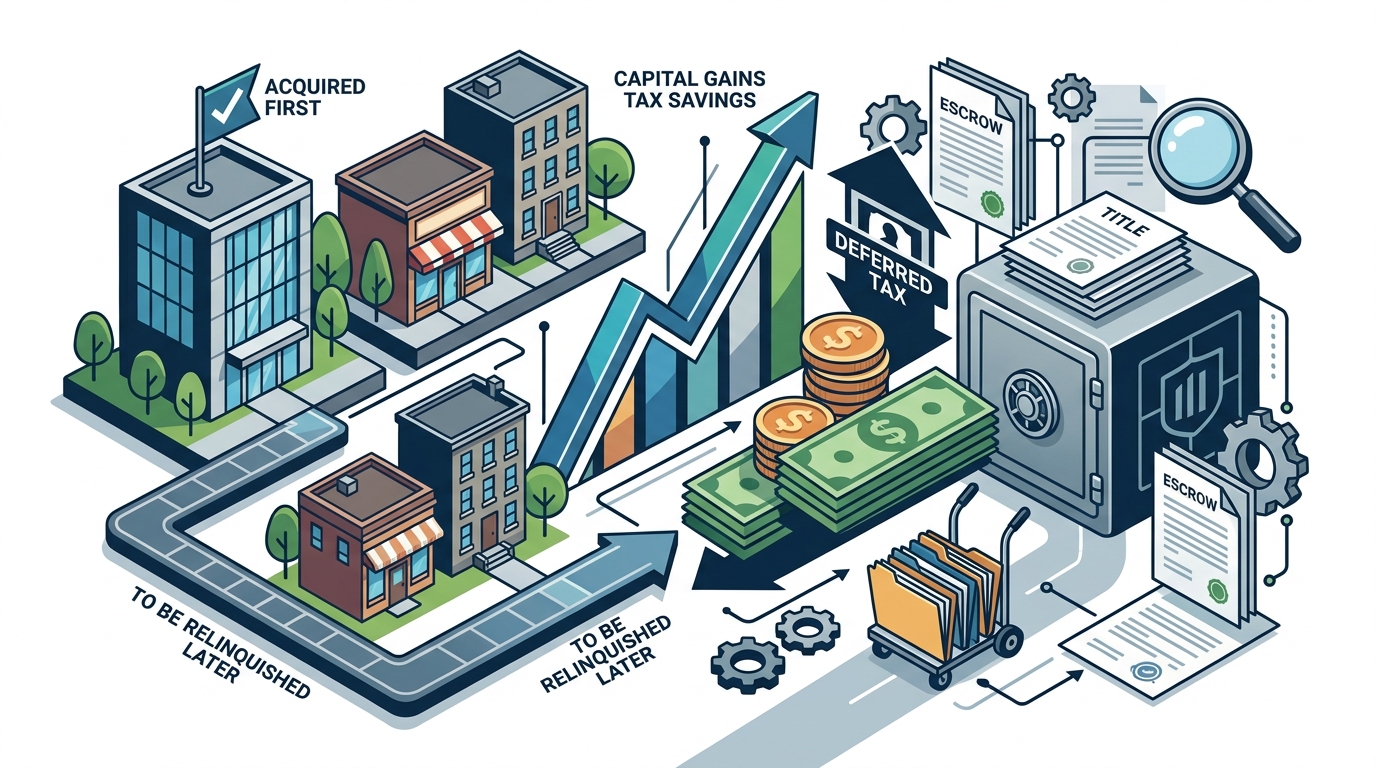
Investors facing high capital gains tax burdens often overlook the most powerful tool in their arsenal: the reverse 1031 exchange. While standard forward exchanges are well-known, the reverse structure allows you to acquire a replacement property before selling your relinquished asset. This strategy is critical for securing high-demand real estate in competitive markets. According to recent market analyses, over 30% of sophisticated real estate investors utilize like-kind exchanges to preserve wealth. This guide details how to execute this complex transaction while maximizing your tax deferral outcomes. (1031 Exchange Alaska Granite)
Understanding the Reverse Exchange Structure
A reverse exchange occurs when you purchase a replacement property before selling your current investment. This is the opposite of a standard delayed exchange. The primary challenge is that you cannot hold title to both properties simultaneously without triggering immediate tax liability. To solve this, a qualified intermediary uses an Exchange Accommodation Titleholder (EAT) to hold the title to the new property. (1031 Exchange Alabama Granite)
Reverse Exchange is a transaction where the replacement property is acquired prior to the sale of the relinquished property. This structure is governed by Rev. Proc. 2000-37. The IRS provides a safe harbor that protects you from being treated as the constructive owner of the new property during the accommodation period. Without this safe harbor, the IRS could argue that you have already received the benefits of the new property, thus invalidating the tax deferral. (1031 Exchange Arkansas Granite)
Granite Exchange Services has guided thousands of investors through this process. We ensure that the EAT holds the property in a manner that satisfies IRS requirements. This allows you to secure your dream investment without losing the tax advantages of the like-kind exchange. The discipline of a private bank ensures your funds are protected throughout this complex timeline. (1031 Exchange Colorado Flat)
Calculating Your Tax Deferral Outcomes
The financial impact of a reverse exchange is substantial. By deferring capital gains taxes, you retain more capital to reinvest. This compounding effect can significantly alter your long-term portfolio growth. For example, if you sell a property with a $500,000 gain, you might owe approximately $100,000 in federal capital gains tax. In a reverse exchange, that $100,000 stays in your pocket.
According to IRS data, the average capital gains tax rate for high-income earners is 20%. When combined with the 3.8% Net Investment Income Tax (NIIT), the total federal burden can reach 23.8%. Additionally, depreciation recapture of 25% applies to the portion of the gain attributed to prior depreciation deductions. A reverse exchange defers all of these liabilities.
Consider the opportunity cost. If you pay taxes immediately, you lose the ability to use that capital for further investments. Over a ten-year period, the compounded growth on that deferred capital can exceed the original tax savings. This is why savvy investors prioritize tax deferral over immediate liquidity. Granite Exchange Services provides a calculator to help you estimate your specific savings based on your state and gain amount.
The Safe Harbor Mechanism Explained
The core of a successful reverse exchange lies in the safe harbor provisions. These rules dictate how the Exchange Accommodation Titleholder (EAT) must hold the property. The EAT must hold the replacement property in an entity such as a limited liability company or a trust. This separation is crucial for maintaining the integrity of the exchange.
Exchange Accommodation Titleholder is the entity that holds title to the replacement property during the reverse exchange period. The EAT must enter into a qualified exchange accommodation agreement (QEAA) with you. This agreement outlines the rights and responsibilities of all parties involved. It ensures that the EAT does not have excessive equity in the property, which could jeopardize the exchange.
Fund security is paramount in this structure. Your funds are held in segregated, FDIC-insured accounts. One account is created per exchange, ensuring that your funds are never commingled with other clients' money. This transparency is a hallmark of our service. We provide detailed reporting so you can track the status of your exchange at any time.
The EAT also leases the replacement property back to you during the accommodation period. This leaseback arrangement must be structured at fair market value. This prevents the IRS from viewing the transaction as a disguised sale. The complexity of these mechanics requires a CES® Certified specialist to manage. Our specialists ensure that every document is executed correctly to protect your tax deferral.
Critical Deadlines and Risk Mitigation
Time is the most dangerous element in a reverse exchange. The IRS imposes strict deadlines that cannot be extended. You must identify your relinquished property within 180 days of acquiring the replacement property. This is a hard deadline. Missing it by one day can result in the disqualification of the entire exchange.
180-Day Rule is the maximum period allowed to complete the sale of the relinquished property after acquiring the replacement property. This period begins on the date you take title to the replacement property. It runs concurrently with the 45-day identification period for the relinquished property. The 45-day clock starts on the date you transfer the relinquished property to the buyer.
Risk mitigation is essential. If you cannot sell the relinquished property within the 180-day window, you will owe taxes on the gain. To mitigate this, we recommend starting the process early. Our team works closely with your real estate agent and attorney to coordinate the closing dates. We also monitor the market conditions to help you time the sale effectively.
Another risk is the fluctuation in property values. If the market shifts during the accommodation period, the value of your replacement property may change. This can affect the like-kind nature of the exchange. Granite Exchange Services advises clients to maintain a buffer in their capital to account for these fluctuations. This ensures that you can always meet the like-kind requirement.
Exchange Structures Comparison
Choosing the right exchange structure depends on your specific goals and market conditions. Below is a comparison of the primary exchange types offered by Granite Exchange Services.
| Exchange Type | Sequence | Primary Benefit | Complexity |
|---|---|---|---|
| Delayed Exchange | Sell First, Buy Later | Simplicity and lower cost | Low |
| Reverse Exchange | Buy First, Sell Later | Secure replacement property | High |
| Construction Exchange | Improve Replacement | Value-add opportunities | High |
| DST Exchange | Passive Investment | No management required | Medium |
Each structure has unique advantages. A delayed exchange is the most common and straightforward. However, it requires you to sell first, which can be stressful in a seller's market. A reverse exchange allows you to buy first, giving you more control. A construction exchange allows you to make improvements to the replacement property. A DST exchange offers passive ownership in institutional-grade assets.
Key Takeaways
- Reverse exchanges allow you to acquire replacement property before selling your relinquished asset.
- The 180-day deadline is absolute and cannot be extended by the IRS.
- Granite Exchange Services has safeguarded over $1 billion in client funds since 2000.
- A CES® Certified specialist is required to manage the complex documentation.
- Funds are held in segregated, FDIC-insured accounts to prevent commingling.
- Tax deferral can save investors hundreds of thousands of dollars in capital gains.
- Rev. Proc. 2000-37 provides the safe harbor for reverse exchanges.
Frequently Asked Questions
What is the main advantage of a reverse exchange?
The main advantage is the ability to secure a replacement property in a competitive market before selling your current asset. This prevents you from missing out on investment opportunities due to timing constraints.
How long do I have to sell the relinquished property?
You have 180 days from the date you acquire the replacement property to close on the sale of the relinquished property. This period includes the 45-day identification window.
Who holds the title to the replacement property?
An Exchange Accommodation Titleholder (EAT) holds the title. The EAT is a separate legal entity that acts as your intermediary during the exchange period.
Can I live in the replacement property during the exchange?
Generally, no. The property must be held for investment or business use. Personal use can jeopardize the like-kind status. However, there are specific rules regarding leaseback arrangements that must be carefully managed.
What happens if I miss the 180-day deadline?
If you miss the deadline, the exchange fails. You will owe capital gains taxes on the sale of the relinquished property. The IRS does not grant extensions for this deadline.
Is a reverse exchange more expensive than a delayed exchange?
Yes, reverse exchanges typically involve higher fees due to the complexity and the need for an EAT. However, the tax savings often far outweigh the additional costs.
Does Granite Exchange Services offer reverse exchanges?
Yes, we are a leading provider of reverse exchange services. Our CES® Certified specialists have completed thousands of successful reverse exchanges.
Begin Your Exchange
Do not let tax liability erode your investment returns. Secure your future with a properly structured reverse exchange. Granite Exchange Services is ready to guide you through every step of the process. Contact us today to schedule a consultation with a specialist.
Start Your Exchange and discover how much you can defer. Our team is available to answer your questions and provide a personalized savings estimate.